Wednesday, May 25, 2016

Pyramids of Cairo

This may sound like the weirdest thing you have ever heard in your entire life, but did you know that the Great Pyramid of Egypt is actually a tomb constructed for Pharaoh Khufu and built in 2450 BC? This was a huge surprise for me:

In size, St. Peter's Cathedral could fit inside it. It's one of the oldest structures in the world (almost 5,000 years old) and the tallest structure until the Eiffel Tower was erected in 1889.

The second largest pyramid was built by Khufu's son Krafra as his tomb:

The white cap is actually the remains of the plaster that encased the pyramid. All the pyramids were covered completely in plaster and painted but only this one has it and it is only partially in tact at the top.

There were 3 pyramids built of significance during this time with the smaller one for Menkaure, the son of Khafra and the grandson of Khufu.

If you take a look at it from this angle, the second pyramid with the plastered top (middle one) looks higher, right? The reason is that King Krafa couldn't physically build a higher pyramid than his fathers' tomb. But he designed it on a higher ridge to intentionally make it look bigger. (History records that he wasn't all that great a king- just imagine his ego in trying to outdo his father).

For the Great Pyramid (really all of them), what intrigued me was how the Egyptians were able to build a structure of 3 million slabs of stone, each weighing well over a ton, in a 20 year timeframe. Mathematically, this would involve installing about 500 tonnes of stone every day and an average of about 20 of the blocks into place each hour, day and night for 20 years straight. One theory is that it was built by 100,000 men. I'm not saying it's impossible, but just imagine trying to manage that project...

The protector of the pyramids, the Great Sphinx of Giza, was built in the same timeframe. This statue was to protect the Kings for all time. Note that the body, paws and tail are a lion's form, representing strength:

Here's a picture of the Sphinx up close:

The site overall is absolutely breath-taking and you are in awe when walking the site in trying to comprehend how man could have built such magnificence. And how it has stood the test of time.

Sunday, May 22, 2016

Continuing Down the Nile

Our tour included several stops that showcased the major temples that were built in Egypt. We stopped in Edfu, one of the best preserved shrines:


This temple, built between 237 and 57 BC, is dedicated to the falcon god of friendship Horus during the Greek/ Roman rule. The architecture style is considerably different with a huge fortress-style temple and walls that that have engravings both inside and out:

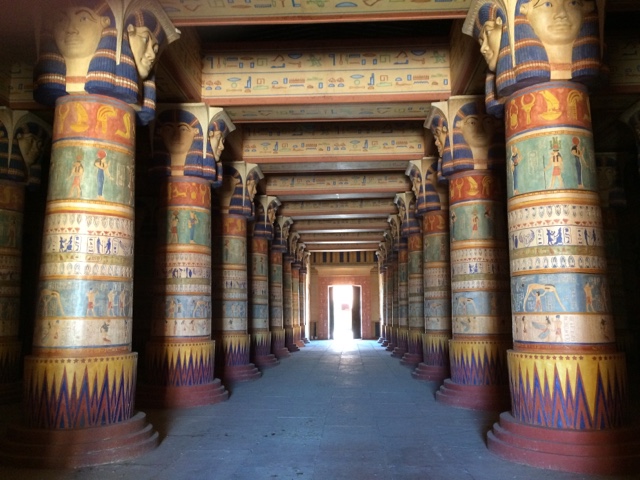
Believe it or not, when all these temples were built (Cairo, Edfu, Kom Ombo, Aswan), the walls and columns were all painted in very rich colors. When we were in Morocco, we visited a film studio and they showed us a 'stage' they built as a replica for part of Edfu. Here's the actual hall inside Edfu:

And here's the studio built version with the colors as it was painted back in 57 BC:
The reason the color is gone is due to age and weather (most were found buried completely in sand).

I want to highlight something else that happened to these temples after Christianity became popular. The Christians started 'erasing' the gods adorning the temples by chiseling off their faces and bodies. Here's just one example where the god Horus is chiseled out:

With all the temples we visited, we saw hundreds of the the god figures have been chiseled out.

A bit further down the Nile is an extremely impressive double temple in the town of Kom Ombo:

It was built around the same time as Edfu for two favored gods- to Sobek the god of power, and Horus the god of kingship and protector of Egypt. The layout combines two temples in one with each side having its own gateways and chapels (two entrances side by side).

Our last stop touring the ancient temples (before we head back up to Cairo) was in Aswan called Philae:

What makes this temple so interesting is that it was completely moved from the location it was originally built back in 200 BC because the new Aswan dam of 1976 submerged it in water. UNESCO and several countries funded the move; there were over 37,000 pieces cut and then transferred over 4 years to its' new location above the dam waters on another island near the original site. This No. 118 below is one of the 37,000 pieces physically moved to the new island site:

I was trying to make sense of why Egyptians worshipped about 500 gods as we've been raised with only one God. Our tour guide explained it this way. Back in ancient times, the people believed that the sun, the moon, fertility, joy, harvests, children- for all of what is given to humans, we could not 'make'. So gods were identified like Hathor, the goddess of fertility and joy; Sobek, the God of power; ISIS (no relation whatsoever to the the current thugs in Syria) was the queen of all gods. And when Christianity came about with only one God, there was a major transformation that took years. 

Of course there is another whole other story of how Mohamed came about and we now have more than a billion Muslims currently on the planet.

Next- Cairo, where it all started.

Friday, May 20, 2016

Cruising 'Down' the Nile

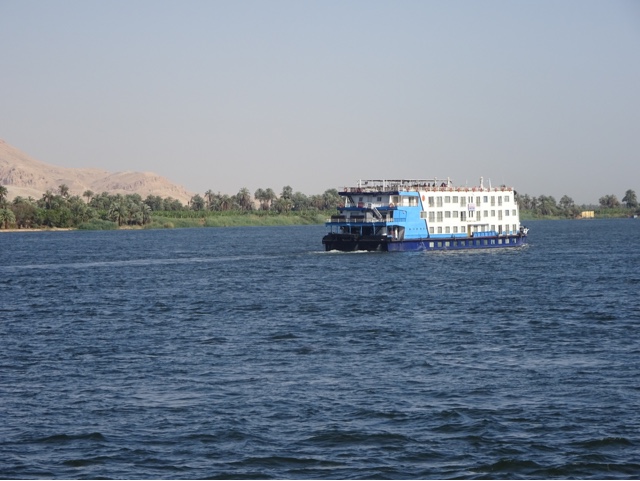
It's interesting to note that although you're going 'down' the Nile from Luxor to Aswan, in reality you're going against the water flow of the Nile. The cruise ships are relatively small with only 50- 70 rooms:

The actual Nile River starts in the south of Africa at Victoria Falls at the border of Zambia and Zimbabwe. The water travels 'up' through to Egypt and eventually into the Mediterranean. The Nile is 6,853 km long and flows through 11 countries. This river is the primary water source of Egypt. Because of the fresh water, there are a variety of crops that grow along the sides including wheat, barley, all types of vegetables, figs, melons, pomegranates and vines for Cathy's wine.

I was surprised that the river is not very wide, from 1- 3 Km on our cruise. Here are views of the East and West side as we go 'down' from Luxor to Aswan.


 At Esna, about 35 km from Luxor, the boat passes through a lock system

The water level in the lock is low here since we are on the lower side of the river. After the gates close, water is pumped into the lock to raise the water level and continue our journey down to Aswan. 

I've tried, for obvious reasons, not to talk politics while I'm here. But it is very evident that the tourist industry has been devastated by the Egyptian Revolution of 2011. Before then, there were 12- 14 million tourists yearly. This year, the country will be lucky to get 1/2 to a million. For Nile cruises, the impact to the economies of Luxor, Esna and Aswan has been especially devastating as this is their biggest industry. Before the revolution, 300 cruise ships sailed the Nile. Today, there are only 5 cruise ships working and our ship was not full. 

To say that Egypt is needing their tourists back is an understatement. 

Thursday, May 19, 2016

Our Egypt Tour

We had decided to be extra, extra cautious with our visit to Egypt so we arranged for guides and drivers during our stay. We arrived safe and sound in Cairo and then to Luxor where we boarded a cruise down the Nile. Our fist stop was to Karnack Temple, 65 acres of ancient ruins. The construction of the temple started during the 16th century B.C. About 30 pharaohs gave a contribution to the buildings, which enabled it to reach a diversity, complexity, and size that is not seen anywhere else in the world.


There are inlaid carvings galore. The figure to the left of this next picture is the God of Fertility.

He is depicted having only one arm and one leg. This is because- so the story goes- during some big wars, while the other gods were off fighting, they left him in charge of the tombs and the temples and he made every woman left behind pregnant. They cut off his arm to punish him.
They went to war again and he remained behind to repeat his offense. This time they cut off his leg. They didn't cut off his penis (perhaps the obvious choice to stop his philandering!) because, well, he was the god of fertility!

There are other statues, King Tut-

And nearby in Luxor Temple, the Ramses II statue:

This king was quite a leader and ruled for 67 years until his death at 96 years of age. During this time, he had 200 wives and sired 96 boys and 102 girls. He was also a great warrior, bringing peace during his dynasty. Busy, busy guy for sure.


Friday, May 13, 2016

Life in Morocco

After Casablanca and Fes, we had the opportunity to do a tour of Morocco with a driver and guide- Mohamed and Lessen. 

We travelled together over 1,400 km and talked throughout the trip about culture, religion and the way of life here. Population wise, Morocco is a bit smaller than Canada (33 million in Morocco versus 35 million in Canada). But the country is half the size of Ontario with about 40% of that being desert. So we got a good look at the country.

From a political and cultural standpoint, Mohamed and Lessen were quite upfront in identifying themselves as Berbers, indigenous to Morocco and North Africa. About half the total population of Morocco are Berbers with 'ordinary' Arabs (Sunni Muslims) making up the difference. Berbers consider themselves true Moroccans. They are die-hard in their pursuit of autonomy versus the 'arabization' efforts that has been happening over many centuries. Apparently the Middle East are saying that everyone is an Arab including Berbers and that they should really be one. But the Berber movement is very alive and distinct. To them, they will forever remain independent.

So it was an interesting discussion when we saw a lot of Arab signs on construction sites (for example a lot of EMAAR Dubai construction). They acknowledge this but tend to ignore any future responsibilities this may entail. And there is construction everywhere, I've never seen so much in cities, towns, villages. The road construction is just one example.

The country is absolutely gorgeous. There are the Atlas mountain ranges (we drove them, not trekked them) from the Atlantic over to Algeria. The landscape from Marrakesh to the south in the Sahara goes from plush greenery to desert and the differences are profound.


Along the edges of the mountains are irrigated lands, the most beautiful being 190 km of Palm trees where they produce dates (did you know that dates are grown only on Palm trees?).

When talking about the problems of Morocco, unemployment is high among the 20- 30 year olds (out of total unemployed, almost 4 out of 5 in this age group) and both Mohamed and Lessen were grateful they had jobs. They both have friends who have gone to Europe for jobs.

One area that stuck with us was the culture they are trying to maintain. When we stopped on our desert excursion, we were treated to tea and there was a spontaneous music session with Mohamed and a friend. For Berbers, on weekends when getting together, they will sing their own music.

They certainly are aware of North American culture and the changing world but they hold their own music and customs quite high; I don't think they will ever give this up.

Finally, bartering is something I'm still getting used to. Apart from groceries, lodgings and restaurants, you barter for everything. It's a cultural thing, it's what people here are born and trained to do. For cabs, I thought I had it down pat. Upfront you negotiate the price. If you don't like it, you go to the next cab and the next. So, arriving in Essaouira, I did just that and got a great price although we had to share with someone. Unfortunately, the cab driver dumped us in the Medina telling us to walk to the left, then right. Turns out, the place we are staying at isn't even in the Medina but 5 km away. So, we walked back to the cabs, negotiated a price and finally got to the Riad where we're staying. I personally don't like it but it's the way of life here.

Next stop- Egypt.

Tuesday, May 10, 2016

The Sahara Desert, Morocco

The Sahara desert starts just outside Marrekesh and we did an overnight excursion out to the sand dunes. What an experience!

If you ever thought a camel ride was going to be a 'walk in the park' may I suggest that you do it at a young age? I say this because riding the sand dunes is kind of like bronco riding while balancing on a hump and you're hoping the camel isn't dumb enough to go down some real- bad slopes! And if you thought your bum gets sore spinning or cycling, try a camel for a 1 1/2 hour trek up and down sand dunes. It will take days to walk normal.

All kidding aside, it was a glorious adventure. The Sahara is unbelievably majestic and quiet. 


There is no sound other than wind; unfortunately this can be quite substantial. Our guide wore the standard turban and asked if we wanted to buy one. 

As we brought along our handy-dandy MEC hats we declined. Well, there's a reason for these turbans. It's to protect orifices and clothes from sand... And there's a lot of it if it's windy. Which is what it was when we were there.

We stayed overnight in the desert which was wonderful; and we got up early to see the sunrise which was spectacular. Why no pictures? Unfortunately, the wind and sand jammed the camera and we couldn't take any pictures (we didn't take an iPhone out in the desert because, like why?). Bottom line- I'm going to very patiently clean the camera to see if I can get it working again.

Thursday, May 5, 2016

Fes, Morocco

Fes is a 3 hour magical train ride east of Casablanca. It has a total population of a million people but it's the Medina (old city) with a population of 400,000 where you're transported centuries back in time. 

Each of the 450 villages in the Medina has their own mosque (you can see the minarets or towers in the skyline), a bakery, running water, a carpenter, a school and a public bath or hammam. There are 9,000 small streets in this collective, the largest in the world, and it is almost impossible to navigate without a guide. There are no cars and the only means of transport is by mule or cart. 

In the medina, the streets are so narrow that at times two people can't walk together. It is the result of 450 villages being built side by side by side starting back in the 9th century. 

What we saw was a small part of the world trying to hold on to the old- in spite of the world changing- and maintaining their traditions. It's an interesting reality- 400,000 people living and working in a medieval city because they like it this way. It's almost like a dream.

We visited a bakery that started over 4 generations ago (his father's grandfather did what he is doing now); still baking in the same open oven and women (or children before school) arriving daily in the morning with their kneaded bread to be baked.


Traditional robes are still made by hand and there are literally hundreds of stalls selling any colour of thread or fabric for those special dresses or men's djellabas (our guide's wife had 3 dresses made by hand for religious and festive occasions).

There are leather tanneries (now supported by Unesco) that have been washing, treating and colouring animal skins into leather goods for over a thousand years and exporting to Spain, France and India.

If we hadn't seen trained ceramic workers making product with our own eyes, we wouldn't believe that the ceramics are all done by hand. Here is a picture of the oldest university in the world (built in the 9th century) with ceramic at the base, then hand-done stucco, then hand-carved wood. When you think of the number of small ceramic pieces being cemented together, it is mind-boggling: 

But what blew us away were the people, how the locals treated us and how friendly they are to one another. Not trying to be hokey, but it's special here. The feeling is one of goodness, genuine interest in meeting you and the pleasure to show their city. We couldn't get over how nicely we were treated- from the taxi drivers, the waiters, the Riad staff where we stayed (what they call small hotels) and the shop-keepers.

Morrocans also have a custom where the men meet up at the local cafe in the evening to have tea or coffee and forget about their work day. 

When asked if women could sit and partake, the answer was that they would probably prefer to sit inside or stay at home with other women and talk while the men are socializing. No surprise here, I found this way of life very appealing; not so much Cathy.