Monday, May 2, 2016

Casablanca, Morocco

It's not that I waited the last 4 months ONLY to get to Casablanca and relive Boghart's lines "here's looking at you, kid" and singing "As time goes by" inside Rick's bar. But I did watch the film (we're talking black and white on an iPad) the night before we arrived here to make sure I remembered the scenery to relive the film. So I was gob-smacked when I realized what I thought happened making the film here and the actual production we're totally different.
                  
This movie, winner of 3 Academy Awards, was filmed during the Second World War in 1942. It turns out the entire picture was shot in a California Hollywood studio (airport views which were also shot in L.A). The horrific news for me was that Rick's bar never existed in Casablanca- ever! 

It was only in 2004, when some bright person decided to cash in on the Hollywood classic that Casablanca got Rick's bar. She built what looked like the bar, lounge and restaurant (it's not remotely authentic).

But this really wasn't the reason at all on why we came to Casablanca- it's really the start of our African tour. There's the Haddan II mosque, second largest mosque in the world and gorgeous:

There's the Medina Marche, where you could buy any conceivable clothes or leather product you're interested in:

There's the fish market which operates throughout the year:

With a population of about 4 million, Casablanca is considered the economic and business centre of Morocco. It's also the start of 'bartering' which is what we'll be doing probably till the end of this year while travelling Africa and Asia. As an example, we needed a cab today and the guy said 300 dirhams; then he quickly dropped it in half to 150; I balked and he said 100 which I thought was a good price. Later in the day, in talking to another driver, he said the ride should have cost us 60... This is going to be fun!!

Friday, April 29, 2016

Tchau Rio!

Today we say goodbye to Rio. This city is one of the most interesting places we've been to so far. It has so many different aspects- culture, food, people, architecture, natural surroundings- rolled up all into one that it's difficult to pick out the best parts. 

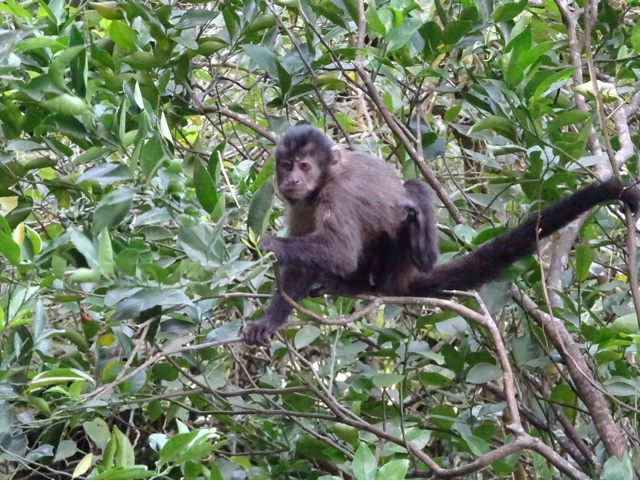
For example, today this guy stole my breakfast bun just as I was going to sit down to breakfast:

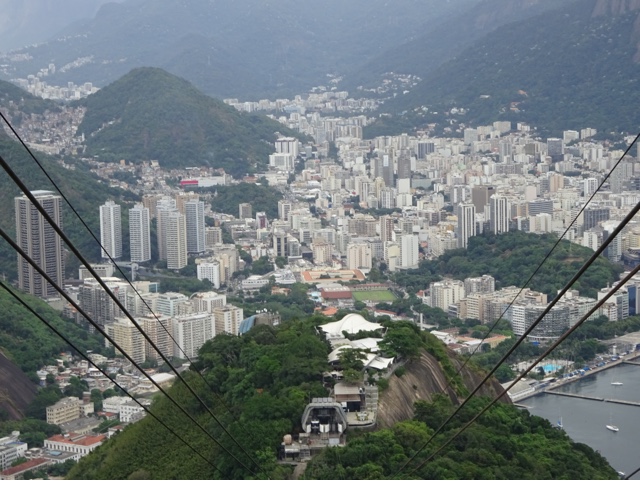
Yesterday we went up the cable cars to Sugarloaf for some amazing views:


We then found a remarkable restaurant not 500 meters away from the base inside a Military School and the view was amazing:

The favelas and the caste system really hit both of us hard as we've not seen anything like it. Even going up the cable cars, you could see sides of mountains with favelas. I mentioned there were over 600 of these in Rio alone; locals say there are over a 1,000 of these neighborhoods  and more than 1.3 million inhabitants ( slightly more than the 1.2 million favela residents in São Paulo Brazil).

The homeless are also quite visible. They are downtown and stay in packs with nothing other than the clothes on their backs.
                
  
With everything that we heard and told to watch out for, we were surprised that we weren't accosted or robbed during our two week stay. We were actually amazed at how friendly the people were and how helpful they tried to be with directions and translations even though English is a very foreign language here. The people are definitely friendlier here than any other part of Central or South America that we've been to.

It's been almost 4 months since we started our Around the World trip and we are now flying over to Casablanca, Morocco to start our journey in Africa!

Tuesday, April 26, 2016

Rio's Beauty and Challenges

Rio is a beautiful city with fabulous beaches (Copacabana, Ipanema, Flemingo) and a city built along the shores of the Atlantic. With SugarLoaf and the National Park around Christ the Redeemer, the views are breath-taking.


But there is another side- quite in your face- and that is their caste system and slums. Locals will be quite upfront in saying they do not have a racial issue but there is absolutely a caste system of the rich versus the poor; and the poor are virtually 100% Afro- Brazilian (locals say Black) that live in squalor.

A brief history- In the 16th- 18th centuries, Brazil imported more slaves than any other country. An estimated five million 'blacks' came here compared to only 400,000 that went to the U.S. and Canada. By 1888, when abolition finally came, there were more black than white people in Brazil. Whereas the US and other parts of the world continued to segregate or apartheid, Brazil decided to encourage a mixed or rainbow race.

Fast forward to today- it may be a rainbow mix but it is definitely a caste system and there’s outright discrimination against poor people. Herein lies the juxtaposition.  Brazilians have long argued that blacks are poor only because they are at the bottom of the social pyramid—in other words, that society is stratified by class, not race. 

It's a striking visual; about 11 million of the Brazilian population live in slums, called favelas. 

There are actual tours you can take to see these. In Rio, there are officially 670 favelas- many with no plumbing and electricity- built beside residential neighborhoods. Even where we are in Santa Teresa, there are favelas built alongside this older neighborhood. They have prime locations and afford some of the city‘s richest views to its poorest citizens. Unfortunately, favelas are also hives of violence and criminal activity, run by drug cartels and their residents are blamed for much of the city's crime.

It's also unfortunate that the Brazilian government has a long history of ignoring the uncontrolled growth of favelas, despite the obvious danger of cobbling houses together on steep hillsides. 

It is recognized that the country has to think 'different' in solving this challenge. But with an impeachable President and the Olympics less than 4 months away, it's not high on the priority list. This hasn't hit the top list for some time.

Wednesday, April 20, 2016

Iguazu Falls- Argentina and Brazil

Breath-taking, magnificent, spectacular! These waterfalls have unbelievable settings within two National Parks along the Iguazu River, one on the Brazilian side, the other on the Argentine side. We spent two days touring and trekking these parks and had some of the best times on our trip so far. (Editorial note: I really like hiking, just not death-defying ones). Also, the weather was gorgeous which added to the beauty and awe-inspiring vistas that we saw.

First the waterfalls- there are over 300 of them. In size, some are a third taller than Niagara Falls and the double and triple-decker falls are breath-taking. As well, they go on for about 3 kilometres. Take a look:


I wanted to also highlight the parks themselves. They are both quite large and meticulously maintained although Argentina has the advantage of bigger size and layout. The trails are well-engineered and give you easy access to several kilometres of pathway into the jungle/ rainforest which is geographically where we are. On the Argentine side, when you enter the park, you have a 15 minute train ride to get to the base of the falls. Then, there are several kilometres of walks/ treks along dozens of beautiful falls. Most of the walkways are on steel walkways which go on for kilometres. On the Brazil side, on entering their national park, you take a double decker bus for 11 kilometres to the base of their falls, then options on several treks to see their falls. Some pictures of waterfalls on the Brazil side:


A little tidbit of information, combining these two parks, there are over 300 species of butterflies. Their season is normally June and July but for some reason, they were very bountiful in April, which is considered the fall season. There were so many butterflies that you'd be walking along and several would be jumping on and off you. Here are some that we saw:


The parks are also home to hundreds of bird species but you have to be up early to see most of them. Cathy and I are not 'early' people so we can't boast that we saw a lot. That said, we were able to see several Plush-crested Jays:

This bird is very people-friendly and can land on your hand if you have some food. 

Speaking of food, Argentina and Brazil have a bad-ass animal called a Quatis, which I would compare to our racoons:


They appear human friendly and are seen around restaurants begging for food. But you're warned- and there are signs- not to feed them because they don't differentiate between food on the ground and a hand that might have food attached to it. 

Sunday, April 17, 2016

These Bandits Stole our Pasta

One of the things our hostess told us yesterday when she was showing us around our new place was that we should be careful with leaving food out in the kitchen as there are monkeys around that might come in and grab stuff. So, immediately, I took my chocolate bars and Pringles and put them in the fridge, knowing that they couldn't get in there. And we were pretty careful making sure that bread, butter and other foods were locked up.

Well, it turns out we didn't put everything away. I was woken up this morning by a pack of monkeys 'invading' our kitchen. At the break of dawn, these guys came jumping onto our balcony and down the steps to the kitchen as quickly as a gale of wind.

They took a sealed bag of dry spaghetti and quickly jumped out the window and onto the trees- then they carefully tore it open and parceled out the goodies. I know we have coyotes and deer by our condo in Toronto- it's just hard to imagine a pack of monkeys in a city the population of 11 million!

Saturday, April 16, 2016

Rio de Janeiro, Brazil

We're staying in Saint Teresa, a neighborhood just outside Rio, affectionately called "Santa" by locals. It's about 10 km from main Rio. We have a direct view from our two balconies where we're staying on Christ the Redeemer, the famous 38 meter statue overlooking the city of Rio. It is listed as one of the New Seven Wonders of the World.

Saint Teresa has a working trolley, first installed in 1872, going down to the main city of Rio. It was a prestigious neighborhood at that time and today is home to many art studios and galleries, restaurants and bars.

The 2016 Olympics are just 4 months away and the locals are laughing as they're not ready, just like the World Cup they hosted a while back. To make matters worse, from a political standpoint, there is a vote tomorrow on possibly impeaching the current President, Rousseff, for tampering with the state budget (stealing from one account to pay for another). Inflation has been horrible since she was elected into office just 2 years ago. For Brazilians, this is a big deal.

As I am a consummate political news junkie, I couldn't be in a better place for the next 2 weeks!

Wednesday, April 13, 2016

Mate is a Popular Drink in Montevideo

Since we arrived in Montevideo, I was fascinated by people of all types- construction workers, professionals, fathers on the side of soccer fields watching their kids- with a cup the size of a small coffee mug and using a 'straw' of sorts to sip a type of drink. It turns out that they are drinking Mate, a tradition here in Uraguay. The cup is called a calabash and the straw is a bombilla.

The drink is made by filling the calabash cup with dried leaves of yerba mate and adding hot water, much like making tea. The mate leaves looks like flat crushed green leaves. The calabash is made from the hard wood of the calabash tree and the bombilla is made of metal (stainless steel and even silver). At the bottom of the bombilla are about a dozen small holes so you can sip the drink with the mate leaves around it.

Uruguayans drink mate just like we drink coffee. You'll see people walking around with a thermos of hot water along with their calabash and bombilla sipping away just like we'd do a Timmies or Starbucks. Although I didn't try it (not sold in restaurants) they say it's bitter and an acquired taste. It certainly is a different way for getting your daily caffeine fix for sure!